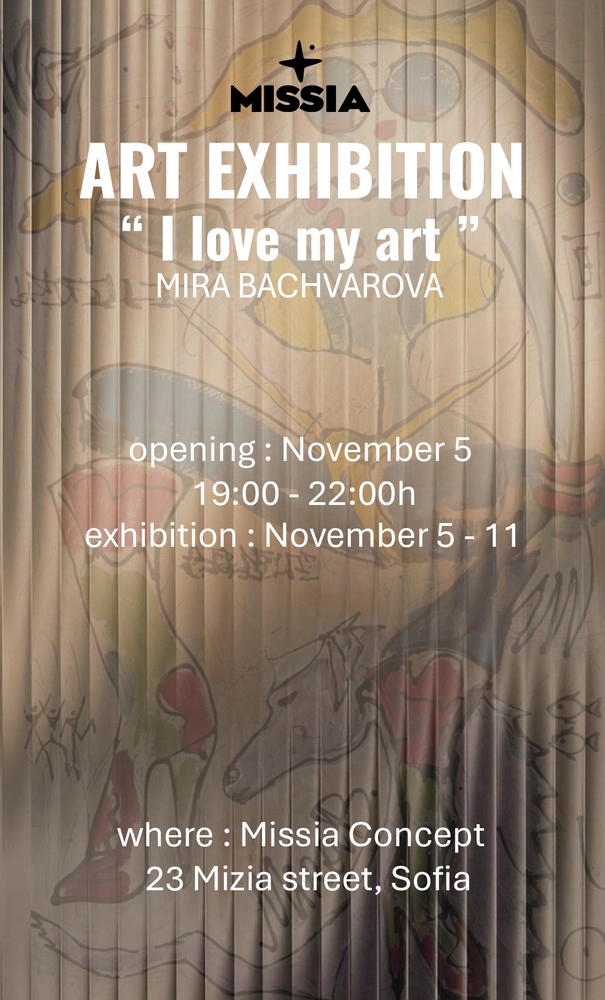
Exhibition: I LOVE MY ART
MISSIA CONCEPT
Представя
ИЗЛОЖБА ЖИВОПИС
МИРА БЪЧВАРОВА
✨ „I LOVE MY ART“ ✨
С огромно удоволствие Ви каним на самостоятелната изложба живопис на Мира Бъчварова, в която ще бъдат представени най-новите ѝ авторски творби — свят, в който изкуството, вдъхновението и страстта се срещат.
Място: Галерия „Missia Concept“, ул. „Мизия“ 23, София
Откриване: 05.11.2026 г.
⏰ Час:19:00ч.
Очакваме Ви, за да споделим заедно една специална вечер, изпълнена с красота, емоции и любов към изкуството!*Изложбата може да бъде разгледана до 11.11.2026 г.
Работно време: 09:00–19:00 ч.
Заповядайте да се потопим заедно в магията на изкуството!** ❤️
Rich painter and poor king - written by Mira Bachvarova
Part I: The Voice in the Dark and the Heavenly Promise
In a huddled hut, cracked open by the wind, where the cold settled in like an unwanted guest, lived a painter. His hands were rough, cracked from the frost and stained with pigments, and his clothes were rags woven from poverty. Years passed, yet the world remained blind to his canvases. No one saw the beauty in his soul, but despite the pain and hunger, he never laid down his brush.
One night, exhausted to the absolute limit, broken by solitude and disappointment, he knelt on the cold floor, raised his tear-filled eyes to the heavens, and decided to address the Creator:
— "Lord… give me a sign. If this is not my path, tell me to stop. Tell me to turn to another path and leave the brush forever."
Then, the room filled with a soft, divine light. The Lord Himself appeared before him. His gaze was full of endless mercy, and His voice echoed like a gentle resonance of eternity:
— "All your life, I have been making you understand how heavy the path of creation is. I led you through thousands of hardships, temptations, and disappointments, yet none of it put out the spark within you. Now, as you sit before Me with hands cracked by the cold, humbled and broken in spirit, how could I tell you anything other than: Keep going!"
The painter looked through his tears, but his mind, clouded by a life of suffering, could not perceive the deep truth. Was his gift not merely the skill to paint, but the unyielding will to stand his ground? Had his spirit remained unbroken despite the storms? He did not understand a single word of God’s message. He wept softly in the dark until fatigue carried him away to sleep.
In the morning, he awoke and looked around his studio in horror. All his canvases—his entire life poured onto cloth—were gone! Nothing was left except the paints. He rushed out of his hut and cried into the empty horizon:
— "Where are my works?!"
At that moment, the earth trembled from the thunder of hooves. A royal warrior arrived on a black stallion. Imperiously, yet with respect, he announced:
— "Rise, painter! The King summons you to the palace. Last night, the Lord Himself appeared to him in a dream and revealed to Him where to find the master who will render him immortal."
Part II: The Golden Cage and the True Portrait
The painter was taken to the lavish royal palace. Suddenly, poverty was replaced by silk robes, the most exquisite royal feasts, and delicate maidens sent to his chambers every night. The King granted him total freedom and took him under his grand patronage.
Rumors spread quickly. All the nobles suddenly clamored for his works. Yesterday’s rejected beggar was today the most fashionable master in the kingdom. But with each passing day, the painter felt something dying inside him. The luxury was sweet, yet hollow.
"How was I meant to make the King immortal? I am just a poor man..." he asked himself.
Then, an idea struck him. He was 50 years old—the exact same age as the King himself. Instead of painting yet another superficial, grandiose portrait complete with crown and scepter, the painter decided to gift the sovereign something far deeper: his story and his truth.
Part III: The Continuation
The painter requested a private audience with the King. When they were left alone in the vast hall by the fireplace, he brought with him neither brushes nor paints.
— "Your Majesty," he began in a quiet but firm voice. "You called upon me to make you immortal. But before I portray you, I wish to tell you about the man God sent to your door."
The painter began to speak. He spoke of his fifty years of earthly hardship. He spoke of the freezing nights when his fingers bled from the frost, yet still held the brush. He spoke of the people who passed by his canvases with mockery, and of his absolute loneliness. And he spoke of that final night—the manifestation of God, the vanished paintings, and the words he had failed to comprehend at the time: "How could I tell you anything other than: Keep going!"
The King listened in silence. As the story unfolded, the deep lines on the ruler's face seemed to deepen further, and his stern gaze softened.
— "Your Majesty," the painter continued. "When I came here, you gave me everything—food, silk, fame, and wealth. But amidst this luxury, I stopped creating with my soul. For art is not born of comfort, but from the fire of the spirit. I have understood what God meant. My immortality was not the paintings that someone could burn or steal. My immortality was my capacity not to be broken, to keep being who I am, despite everything."
Then, the painter drew a small, unassuming canvas from his cloak, which he had sketched that very morning using simple charcoal. On it, the King was not depicted with a crown and warriors. Instead, two men's faces were drawn—one in rags with cracked hands, and the other with a crown and weary eyes. Yet both bore the exact same wrinkles, and both possessed the exact same gaze looking out toward eternity.
— "This is your portrait, my King. Immortality cannot be bought with gold, nor sealed with flattery. You will remain immortal not when people bow before your riches, but when you teach your soul to stand for the truth just as I stood for my art in poverty."
The King stared at the canvas. A tear rolled down his aging face. In that moment, he understood why God had sent him this very beggar.
The Moral for the King
1. True worth cannot be bought with power and gold: The King possessed the entire kingdom, yet he was poor in eternity. He realized that kingdoms crumble, crowns rust, and gold loses its shine. The only thing that remains after a man is gone is the imprint of his spirit and the truth he stood for.
2. Immortality lies in endurance: The King realized that what makes him immortal is not the flattery of courtly subjects, but the strength to pass through life's trials with a pure soul and an unbroken will.
3. Beauty and truth are born in humility: The ruler came to realize that his greatest teacher was neither a philosopher nor a general, but a humble 50
-year-old beggar with cracked hands, whose greatest wealth was that he never betrayed himsel.